Sustainability has been a talking point in large format printing for years, but it generally stays at the level of recyclable substrates, lower-VOC printing, and energy-efficient equipment. But what happens after the campaign ends and those huge banners come down?
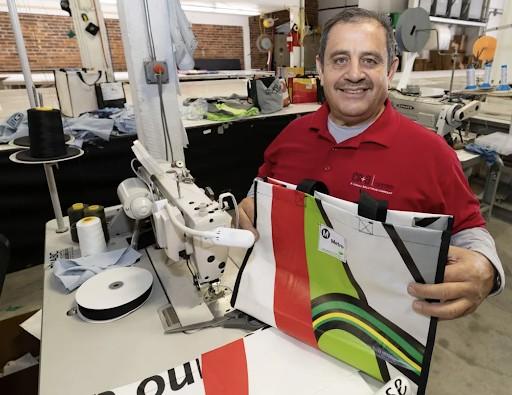
A sustainability initiative by the Los Angeles County Metropolitan Transportation Authority (aka “Metro”) highlights an innovative idea: Instead of treating banners and signage as disposable, they looked at those materials as raw inputs for something new. Retired transit banners found a second life when they could be transitioned into consumer tote bags.
That kind of thinking lines up closely with how CR&A Custom approaches large format printing and environmental responsibility.
The Reality of Large Format Campaigns
If you’ve worked on a major event, retail rollout, or brand activation, you already know the cycle of Design, Print, Install, De-install. When the campaign ends, what’s left behind is often a large volume of durable material that was built to last through weather, UV exposure, and heavy use.
Vinyl banners, mesh wraps, barricade graphics, wall coverings aren’t materials that break down easily. They’re engineered for durable performance. The challenge is figuring out what comes next once the campaign is over. For years, the default answer was simple disposal, but that’s changing.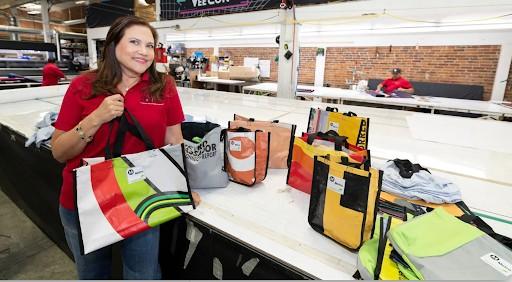
Designing with the End in Mind
One of the biggest shifts happening right now is upstream. Instead of asking what to do after the campaign, more clients are starting to ask the question earlier.
Can this material be repurposed?
Can it be cut, sewn, or reworked into something else?
Can we plan for reuse before we even go to print?
In reinventing the process, CR&A Custom works with brands to select the right substrate and to determine how print layouts might be segmented later. The finishing process considers both installation and disassembly. Our certified team helps our clients think through these decisions early, especially on high-visibility projects where material volume is significant.
From Graphics to Functional Products
The Metro example takes something purely promotional and turns it into something practical. A banner has a short life as a marketing asset, but it can have a much longer life as a product. That same idea can apply across a wide range of applications:
Retail graphics can be repurposed into branded merchandise. Barricade wraps can be cut down into smaller promotional items. Fabric prints can be reused for internal displays or giveaways.
It’s not always a perfect one-to-one conversion, but when it works, it extends the value of the original investment and keeps material out of the waste stream.
Logistics Matter More Than You Think
Repurposing sounds simple on paper, but execution is critical. You need a plan for materials collection and storage after de-installation. A full-service print partner like CR&A is needed to cut, sew, or transform the material.
CR&A Custom often helps in coordinating those steps. Because our team is already involved in production and installation, it’s easier for us to help build a closed-loop process.
That’s one of the advantages of working with a partner with the full-service capabilities to manage projects end to end. The same team that installs the graphics can also help recover and redirect them.
Balancing Sustainability and Practicality
Not every project needs a second-life program. Shipping materials across the country to be repurposed can cancel out the environmental benefit. Storing unused graphics indefinitely doesn’t solve anything either. The goal is to find the right balance.
For some clients, that means choosing recyclable materials and calling it a day. For others, it means building a full reuse program tied to brand storytelling. For large civic or corporate initiatives, it can become part of a broader sustainability strategy.
The key is making decisions based on scale, logistics, and actual outcomes, not just good intentions.
Where This Is Headed
Programs like the one from LA Metro are a sign of where things are going. Brands, cities, and organizations are starting to look beyond the campaign itself and think about lifecycle.
That shift is changing how projects are scoped, how materials are selected, and how success is measured.
CR&A Custom continues to work with clients ranging from movie studios to sports & entertainment companies who want to push in that direction. Sometimes that means small adjustments. Other times it means rethinking the entire workflow from design through post-installation.
Either way, the conversation is moving forward. And in an industry built around creating visual impact at scale, that’s a change worth paying attention to. Contact our team to explore how we can make your next large format print project more sustainable.