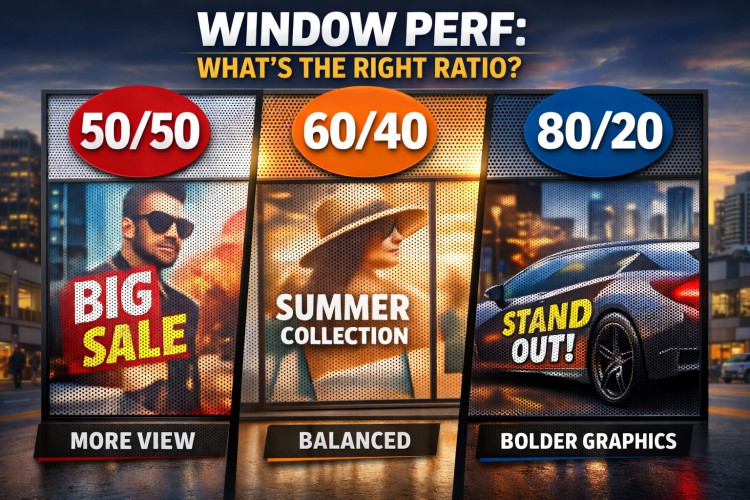
Perforated window film, often called window perf, solves a common problem in large-format graphics. For retail or hospitality brands that want bold, full-coverage branding on glass, but also need visibility from the inside looking out, the solution comes down to a simple concept: a printable vinyl surface with a pattern of tiny holes.
Looking at the graphic from the outside, the printed image is bold and apparent. Looking out from the inside, you’ve got clear visibility through the holes.
CR&A Custom has been printing window graphics for local and national brands for more than three decades. Our team understands the technical aspects of window perf so we help you choose the ratio that’s right for your project.
Where it gets technical is in the ratio of perforation.
Ratios like 50/50, 60/40, and 80/20 each define how much of the material is printable vinyl versus open perforation (i.e., holes)..
So 60/40 film, for example, means 60 percent printable surface and 40 percent open holes.
That ratio you choose directly affects three factors in the graphics: image quality, visibility, and durability.
How the Ratios Work in Practice
50/50 Perforation
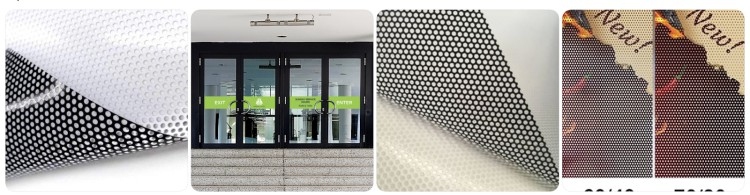
A 50/50 film has equal parts vinyl and open space. This creates the highest level of visibility from the inside. If you’re standing inside looking out, it feels more open and less obstructed than other options.
The tradeoff shows up on the exterior. With only half the surface available for printing, your image density drops. Colors appear lighter, and fine detail gets lost. From a distance, graphics can look slightly washed out.
50/50 is typically used where interior visibility matters more than visual impact. Think about transit windows, office interiors, or situations where occupants need a clear outward view throughout the day.
60/40 Perforation
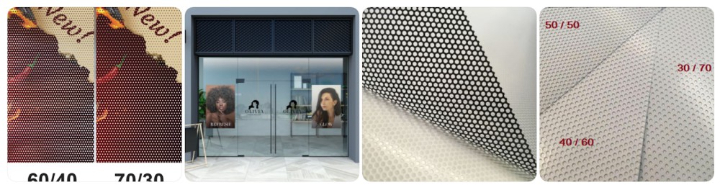
60/40 is the industry standard, because it strikes a practical balance between graphic performance and interior visibility.
With 60 percent printable surface, colors appear more solid and images hold their detail better than 50/50. At the same time, 40 percent openness still allows for usable visibility from inside, especially in daylight conditions.
Most retail storefronts, restaurant windows, and commercial branding applications land here. You get strong curb appeal without completely sacrificing the interior experience.
If there’s one “default” choice for window perf, 60/40 is it.
80/20 Perforation
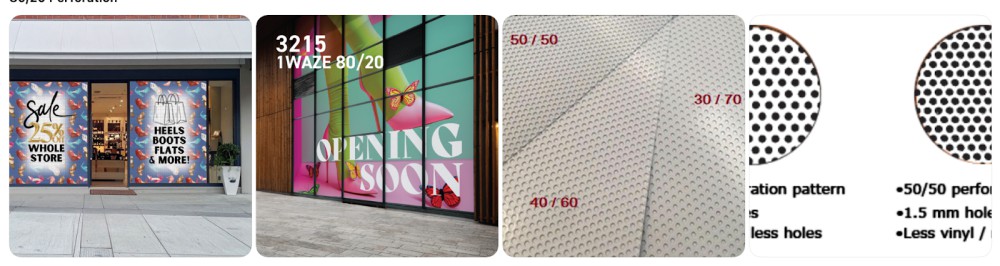
80/20 flips the priority toward image quality. With an 80 percent printable surface, you get rich color, strong contrast, and sharp detail. From the outside, it reads much closer to a solid vinyl graphic.
The holes are smaller and fewer, which reduces interior visibility. You can still see out, but it’s noticeably darker and more filtered, especially at night or in low light.
80/20 works best when branding impact is the priority. Large-scale retail graphics, event activations, and high-end storefronts often use this ratio to achieve a more premium visual result.
Key Technical Considerations
The ratio is only one piece of the equation. Performance depends on how the film is printed, laminated, and installed.
Ink density matters. UV and latex printing tend to produce more opaque coverage, which improves outward visibility but can slightly reduce inward clarity. Solvent inks can feel more breathable visually but may require more careful color management.
Lamination is critical, especially for exterior applications. A clear overlaminate protects against abrasion, UV exposure, and moisture intrusion. Without it, dirt and water can collect in the perforations, reducing visibility from the inside and degrading the image over time.
Glass conditions also play a role. Tinted glass, double-pane units, and interior lighting all affect how the perf reads from both sides. Night conditions are where most clients notice the biggest shift. When interior lights are brighter than outside, the one-way effect diminishes regardless of the ratio.
Installation technique matters just as much as material choice. Proper alignment, edge sealing, and avoiding stretch during install all contribute to long-term performance. Poor installation can lead to lifting edges, distorted holes, and reduced lifespan.
Choosing the Right Ratio
The decision comes down to what you prioritize.
If interior visibility is critical, 50/50 makes sense.
If you want a reliable balance that works in most commercial settings, 60/40 is the safe and proven choice.
If the goal is maximum visual impact and high-resolution graphics, 80/20 delivers the strongest result.
In real-world applications, most projects end up at 60/40 or 80/20. The right call depends on how your space is used, how the glass is oriented, and how important that outward view is to the people inside.
Window perf looks simple on the surface. In practice, getting it right requires understanding how these variables interact once the graphic is on glass, exposed to light, weather, and daily use.
Let our experts help you choose the right perf ratio for your next window graphics job. Contact us today for a free consultation.